About This Book
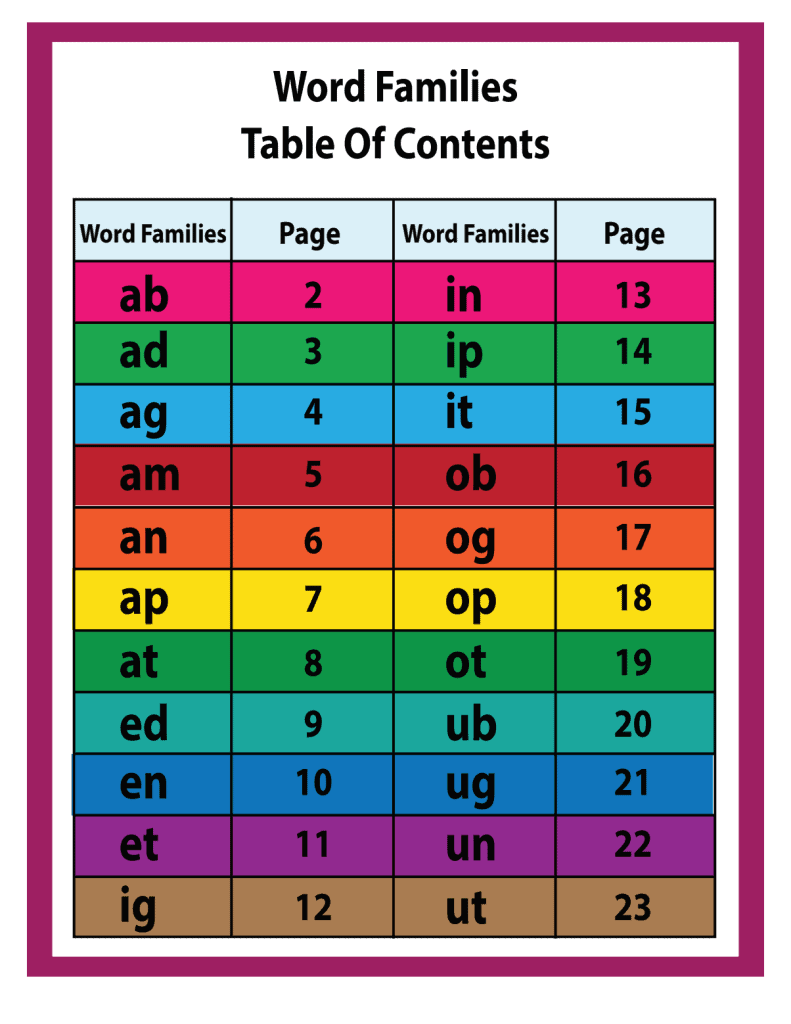
Word Families – Fun & Engaging Worksheets for Early Readers is a worksheet set on word families for early readers. The destination page is headed ‘Word Families’ — this set’s subject in the host’s short form — and the file it serves, ’16. Word Families.pdf’, carries the same name under the host’s numbered preschool-collection filename form (16.) — the same worksheets under the filename the site serves them by. The set’s work is pattern-based decoding: words that share an ending taught as relatives, so a beginner’s effort compounds instead of resetting at every new word.
Word families are the beginner’s best economic news. Pure letter-by-letter decoding charges full price for every word; family learning amortizes — the shared ending is bought once and spent across every relative, leaving only the changing onset to be read fresh. Cognitive science has a name for the gain: chunking, the mind’s way of treating a familiar cluster as one unit, and the rime is the first chunk a young reader can actually own. The pedagogy follows the delight: children sort words into their families, build new members by swapping beginnings, and read family lists aloud in rhyming runs that make the pattern audible as well as visible. That rhyming run is not a garnish — the ear confirms what the eye suspects, and words learned by eye and ear together retire from the decoding queue twice as fast. Teachers watch for the transfer moment, when a child meets an unlisted family member in a real book and reads it without ceremony: the family has become a tool, not a topic.
What Learners Will Practise
Reading the Chunk
Learners practise treating shared endings as single units. A chunk read whole is working memory saved for meaning.
Swapping the Onset
The set practises building family members by changing beginnings. Building a word teaches its architecture better than meeting it does.
Meeting Relatives in the Wild
Children practise spotting family members inside real reading. Transfer to books is the family’s graduation test.
Key Features
The amortization is the feature: endings bought once, spent across every relative. The two-channel learning is the second — rhyme for the ear, pattern for the eye — and the shelf fit the third, this families set beside this list’s recognition and vowels sets. On this shelf it gathers the families here.
Who This Book Is For
Early readers outgrowing letter-by-letter are its first audience. Teachers form its second readership, building the pattern curriculum. Parents make its third, watching rhymes become reading.
How to Use This Book
Say each family aloud as a rhyming run before any worksheet begins; the ear should meet the pattern first. When a new member appears in story reading, pause and name the family — the celebration teaches the hunting. Keep finished families posted where reading happens, as a growing map of owned territory.
Related Books
The word-recognition set stands at Fun & Free Word Recognition Worksheets – Improve Reading Skills, and the vowels set at Vowels – Fun & Engaging Worksheets to Learn Short and Long Vowels.