About This Book
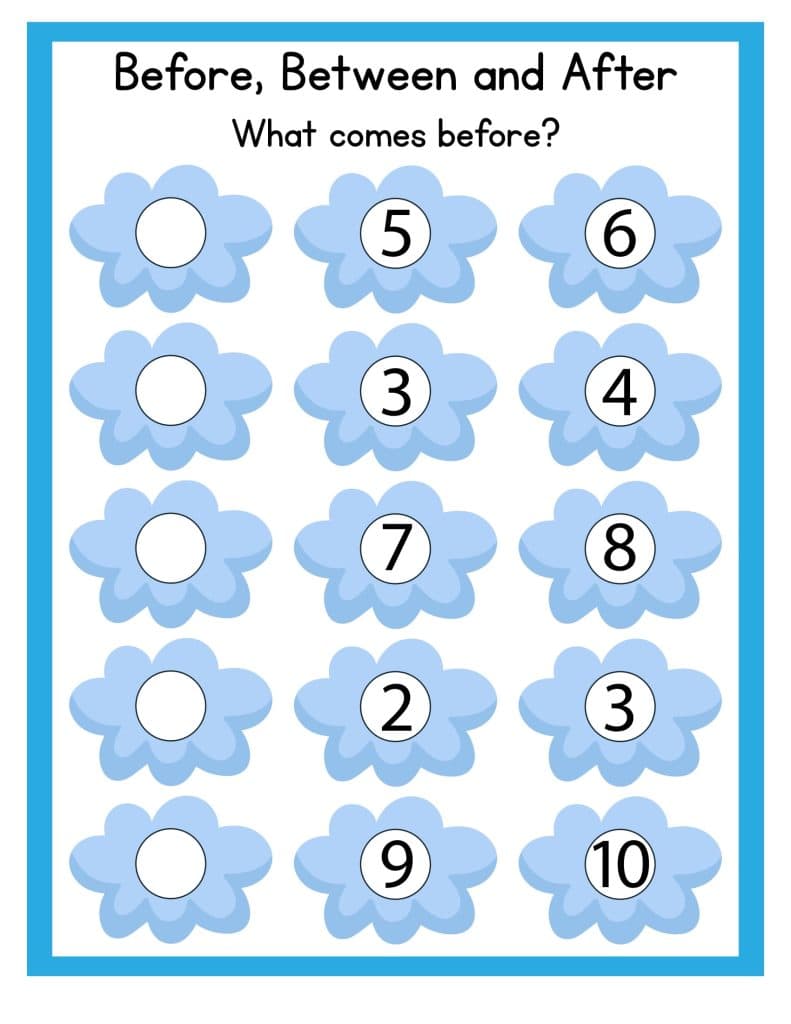
Before Between and After is a worksheet set teaching the positional and sequence words ‘before’, ‘between’ and ‘after’ to young children, through pictures of objects and characters in arrangement. The destination page is headed with this post’s exact title, and the file it serves, ’20. Before, Between and After.pdf’, carries the set’s name — commas included — under the host’s numbered preschool-collection filename form (20.) — the same worksheets under the filename the site serves them by. The set’s work is deceptively foundational: giving children words for relative position, the first abstract vocabulary they will ever own.
Position words are a child’s first philosophy. Nouns name what can be pointed at; ‘between’ names a relation, invisible in itself, existing only between things — and a child who can wield it has crossed from labelling the world to describing its structure. The three words in this set form a complete little system: every object in a line is before something, after something, or between two somethings, and the worksheets’ rows of pictured characters make that system visible, arguable, and therefore learnable. The downstream stakes are unusually wide. Mathematics will need exactly this trio for the number line; reading will need it for retelling (‘what happened after?’); the playground needs it hourly for justice. Teachers note the telltale moment the words land: children stop shoving for position and start litigating it — ‘I was before him!’ — which is civilization arriving, one preposition at a time. Worksheets earn their keep here precisely because the concept cannot be pointed at — only pictured, compared, and talked into existence.
What Learners Will Practise
Naming Relative Position
Learners practise saying where a pictured thing stands relative to its neighbours. Relation-words replace pointing, and description is born.
Reading a Line Both Ways
The set practises before from one end and after from the other. Position depends on viewpoint — the set’s quiet second lesson.
Sequencing in Sentences
Children practise using the three words in spoken claims. A word used in an argument is a word owned for life.
Key Features
The complete trio is the feature: a closed system of position, learnable whole. The double curriculum is the second — maths and story both draw on it — and the shelf fit the third, the sequence set beside this list’s AIC collection and colour-by-numbers sets. On this shelf it orders the line here.
Who This Book Is For
Young learners meeting abstract order are its first audience. Teachers form its second readership, laying two curricula’s track at once. Parents make its third, presiding over the fairness court.
How to Use This Book
Stage the words with real children in real queues before trusting the worksheets; bodies learn ‘between’ fastest. Let learners argue the answers aloud — a defended position, in both senses, is the lesson. Return to the set when story-retelling begins; the same three words run it.
Related Books
The AIC collection stands at AIC WORKBOOKS AND WORKSHEETS FOR KIDS, and the colour-by-numbers set at Color by Numbers.