About This Book
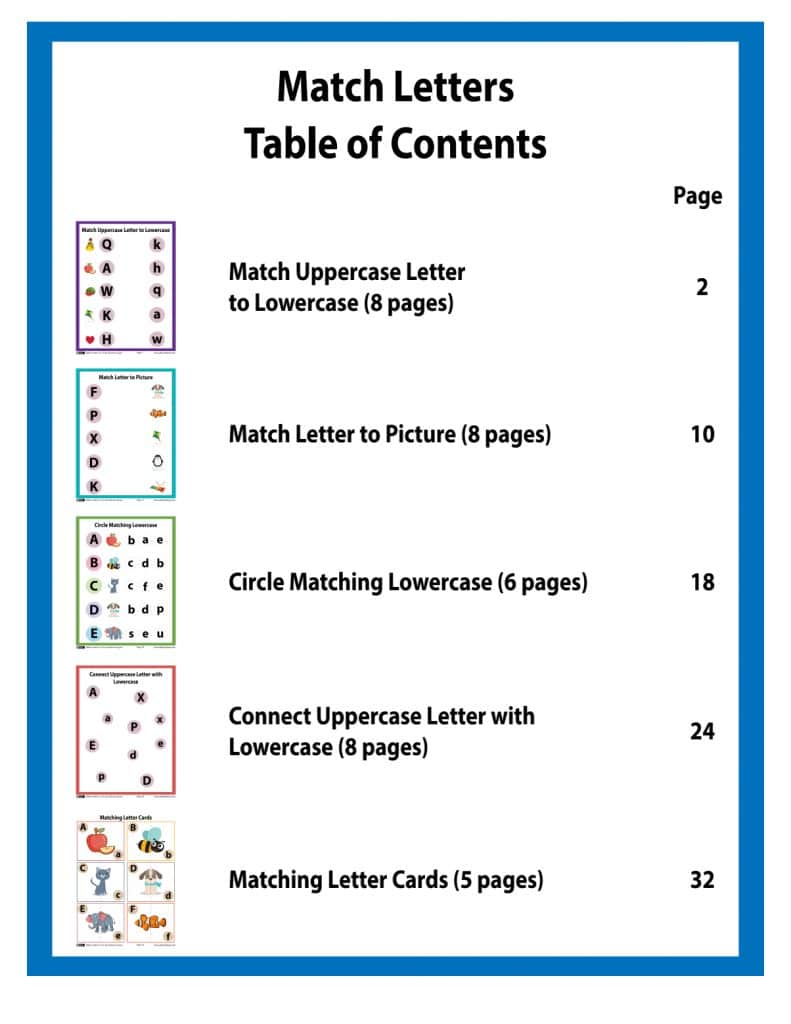
Match Letters – Fun Alphabet Matching Worksheets for Kids is a worksheet set of alphabet matching games for children. The destination page is headed ‘Match Letters’ — this set’s subject in the host’s short form — and the file it serves, ’10. Match Letters.pdf’, carries the same name under the host’s numbered preschool-collection filename form (10.) — the same worksheets under the filename the site serves them by. The set’s work is identity across variation: the same letter recognized in its capital, small, and differently styled forms, until the recognition is instant and free.
Adults forget how strange the alphabet looks at first: not twenty-six symbols but, to a beginner’s eye, fifty-two — each letter arriving with an unrelated twin. A and a share nothing visible; G and g are practically different species. The beginner must learn, letter by letter, that these pairs are one identity in two costumes, and then learn it again for every font the world prints. Matching games are the precision instrument for that learning because they make sameness the explicit question: are these two the same letter or not? Each correct pairing files the variants together in memory, and each filed pair permanently reduces the visual noise of every future page. This is why matching precedes writing in every sane sequence — the hand cannot be asked to produce what the eye cannot yet reliably identify — and why the games repay their time so visibly: children who match fluently start finding ‘their’ letters everywhere, on signs and cereal boxes, which is recognition escaping the worksheet and colonizing the world, exactly as intended.
What Learners Will Practise
Capital-Small Pairing
Learners practise joining each capital to its small partner. The alphabet’s two wardrobes become one household per letter.
Same Letter, New Costume
The set practises recognizing letters across style and weight changes. Identity that survives costume changes is identity actually learned.
Odd Letters Out
Children practise spotting the letter that does not belong in a set. Exclusion sharpens the boundaries that pairing builds.
Key Features
The identity focus is the feature: sameness across disguises, the alphabet’s unglamorous foundation. The game format is the second — pairing as play — and the shelf fit the third, this matching set beside this list’s rhyming and cursive sets. On this shelf it pairs the letters here.
Who This Book Is For
Children meeting letters as strangers are its first audience. Teachers form its second readership, sequencing recognition before writing. Parents make its third, dealing the pair-games.
How to Use This Book
Name every letter aloud as it is matched; the sound should move in with the shapes from the first day. Honour the hunt beyond the page — letters spotted on packaging count double. When a pairing keeps failing, shrink the field: mastery over six letters beats fog over twenty-six.
Related Books
The rhyming set stands at Rhyming Words Worksheets – Fun & Free Printables for Kids, and the cursive set at Cursive Alphabet Trace & Write – Free Printable Worksheets.